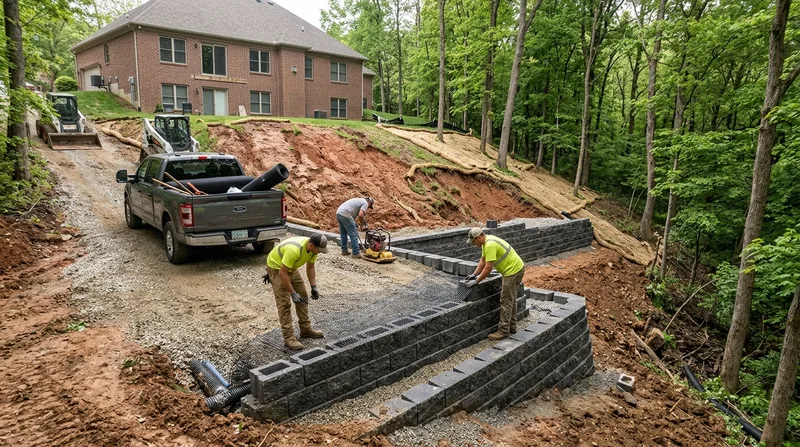




Indianapolis sits on the flat glacial till plain of central Indiana, but the White River, Fall Creek, Eagle Creek and Williams Creek cut through wooded ravines and bluffs, especially on the north side, creating slopes that demand expert stabilization. Homes in Irvington, Meridian-Kessler and Butler-Tarkington, along with 1950s ranches and newer walkout subdivisions in Hamilton and Johnson counties, face constant pressure from slope stabilization and erosion control challenges. Spring downpours, freeze-thaw cycles and frost heave push aging walls out of line and erode creek banks and pond slopes. Dense clay till holds water and accelerates failure. We install terraced retaining walls, geogrid reinforcement and erosion control systems that protect your home, driveway and yard from collapse and water damage. Call (463) 217-0386 for a free estimate, or learn more about retaining wall installation for new construction.
Why Slope Stabilization Matters in Indianapolis: Protecting Your Property From Frost Heave and Erosion
Central Indiana's clay-heavy soil and seasonal freeze-thaw cycles create unique pressure on slopes and creek banks. Winter cold penetrates the dense till, ice forms within the soil profile, and spring thaw releases water that weakens wall footings and erodes unprotected slopes. Homes on ravine lots, creek banks and graded properties in Indianapolis, Carmel, Fishers and Noblesville face active subsidence and wall movement every year. Ignoring early signs like horizontal cracks, bulging or tilting walls leads to catastrophic failure, flooded basements and property loss.
- We stabilize creek banks and ravine lots with terraced retaining walls that distribute load evenly and resist frost heave.
- We install geogrid reinforcement behind walls to anchor soil and prevent lateral movement during spring thaw.
- We grade slopes with proper drainage to shed water away from foundations and wall footings.
- We replace aging railroad tie and timber beds that have rotted and lost structural integrity.
- We design tiered systems for steep lots where a single wall cannot span the full height safely.
Early intervention prevents costly repairs and foundation damage down the line.
Key info: A ravine lot in Irvington or a walkout basement in Greenwood can experience 2 to 4 inches of wall movement in a single spring season if drainage fails. Homeowners who address slope erosion before walls crack save thousands in foundation repair costs. The Indiana Department of Natural Resources provides guidance on creek bank stabilization at www.in.gov/dnr/. Always check with your local building department before starting work, as walls above 4 feet or supporting surcharges typically require a permit and engineered drawings.
How We Stabilize Slopes in Indianapolis: A Step-by-Step Approach
Slope stabilization is not a one-size-fit-all job. We start with a site inspection to measure slope angle, assess soil type, identify water flow patterns and understand what loads the wall must support. Clay till in Indianapolis requires deeper footings and better drainage than sandy soils elsewhere. We design a system that resists frost heave, handles spring runoff and distributes weight safely to bedrock or stable subgrade. Learn more about retaining wall drainage solutions that work with our slope stabilization plans.
- We excavate the slope to remove loose soil, rotted wood and failed wall material back to stable ground.
- We install a compacted gravel base and geotextile fabric to separate soil from drainage stone.
- We build the retaining wall (block, poured concrete, stone or timber) with proper setback and batter to resist overturning.
- We backfill with drainage stone and geogrid layers, compacting in 6-inch lifts to achieve proper density.
- We grade the top of the slope to direct water toward storm drains or swales, away from the wall and foundation.
- We install erosion control matting or seeding on exposed soil to prevent surface runoff from washing away topsoil.
This staged approach ensures long-term stability and protects against the freeze-thaw cycles that dominate Indianapolis winter failure.
Real example: A homeowner on a ravine lot in Lawrence called us after spring thaw opened a 3-inch horizontal crack in a 20-year-old timber retaining wall. We removed the failed wall, dug down 4 feet to stable clay, installed a segmental block wall with geogrid reinforcement, and graded the slope with French drain tile running to daylight. Cost was $8,500. Without intervention, the wall would have collapsed into the creek and taken the yard with it.
Slope Stabilization Methods: Choosing the Right System for Your Indianapolis in Indianapolis and surrounding areas
| Approach | Description | Best for |
|---|---|---|
| Segmental Block Wall with Geogrid | Interlocking concrete blocks stacked with geogrid reinforcement between lifts, creating a flexible, reinforced structure that resists frost heave and lateral movement. | Walkout basements, pond slopes, creek banks. Most common in Indianapolis suburbs. Handles 4 to 12-foot heights. Cost-effective and durable. |
| Poured Concrete Wall | Monolithic concrete wall cast in place with reinforcing steel and a concrete footing below frost line. Rigid and strong, resists overturning on steep slopes. | Driveway cuts, steep ravine slopes, high-load applications. Best where slope angle exceeds 45 degrees or surcharge is significant. Indianapolis clay till requires proper drainage behind wall. |
| Natural Stone or Boulder Wall | Indiana limestone blocks or boulders stacked dry or mortared, often with soil and geogrid backing. Blends with landscape and regional aesthetic. | Garden slopes, low to moderate heights (3 to 6 feet), visible garden walls in Irvington and Meridian-Kessler. Less effective on tall ravine slopes where reinforcement is critical. |
| Terraced Walls with Benching | Multiple shorter walls stacked with level benches between them, each backed by drainage stone and geogrid. Distributes load and allows vegetation on benches. | Very steep lots (50+ degree slopes), large elevation changes, areas where a single wall cannot be safely constructed. Common on ravine lots in north Indianapolis. |
| Erosion Control Matting and Slope Seeding | Coir or jute matting pinned to exposed slope, seeded with native grasses and legumes. Stabilizes soil surface and prevents surface erosion during establishment. | Gentle slopes (less than 3:1 grade), bare soil after wall installation, creek bank stabilization. Must be combined with structural walls on steep or high-load slopes. |
Slope Stabilization and Erosion Control Cost in Indianapolis: What to Expect
Cost for slope stabilization depends on wall height, slope length, soil conditions, access and whether the wall must support a surcharge like a driveway or structure. A modest 4-foot segmental block wall on a 30-foot slope with good access in Indianapolis runs $4,500 to $7,500. A poured concrete wall on a steep ravine lot, 8 feet tall with geogrid and drainage, ranges from $12,000 to $18,000. Terraced systems on very steep lots in Carmel or Fishers can exceed $25,000. We provide a free estimate after a site visit. Call (463) 217-0386 to schedule. See our full pricing overview for more detail on what moves the cost up or down.
Factors that increase cost include deep footings required by clay till, high groundwater that demands robust drainage, removal of failed walls or trees, and engineered drawings for walls above 4 feet or supporting structures. Getting 2 to 3 estimates from licensed contractors is smart. Compare the scope of work, materials, drainage design and warranty, not just the bottom line. A cheap estimate often means shortcuts on footing depth or drainage that fail within a few years.
Slope Stabilization and Erosion Control Near Me: What Indianapolis Homeowners Should Know When Hiring
Slope stabilization is a regulated service in Indianapolis and surrounding jurisdictions. Walls above 4 feet measured from the footing, or any wall supporting a surcharge such as a driveway or building, typically require a building permit and engineered drawings. Setback and property-line rules vary by township and city. Before hiring a contractor, verify permit requirements with your local building department. We handle all permit applications and work closely with inspectors to ensure compliance. Licensed and insured contractors carry liability insurance and workers compensation, protecting you if an accident occurs on your property.
- We obtain all required permits and coordinate with local building inspectors before and during work.
- We provide references from homeowners in Indianapolis, Carmel, Fishers and Noblesville who have had slope stabilization work completed.
- We explain the scope of work in writing, including wall height, materials, drainage design and timeline.
- We discuss HOA rules if your property is in a community with design guidelines or approval processes.
- We warranty our work against structural failure for five years and stand behind materials and labor.
Contact us at Indianapolis Retaining Wall for a free estimate and to discuss your specific slope or erosion concerns.
Slope Stabilization & Erosion Control in Indianapolis: Pricing Guide
| Service | Price | Details |
|---|---|---|
| Free Estimate and Site Visit | Free | No obligation consultation to assess slope angle, soil type, wall height needed and drainage requirements |
| Small Slope Stabilization (4-6 feet, 20-30 feet long) | Starting at $4,500 | Segmental block wall with geogrid, compacted drainage stone, grading and erosion control matting included |
| Medium Slope or Ravine Wall (6-10 feet, 40-60 feet long) | Starting at $9,500 | Poured concrete or block wall with engineered footing, robust drainage, terracing if needed, and slope seeding |
| Large or Terraced System (10+ feet, multiple walls, complex site) | On estimate | Detailed site survey, engineered drawings, deep footings and multi-stage drainage required before pricing |
| Travel and Site Inspection | Included | No mileage charge or separate call-out fee for Indianapolis and surrounding service areas within 30 miles |
| Estimate Response Time | Free | Response within 24 hours at (463) 217-0386, no obligation to book if estimate does not meet your budget |
Indicative pricing, the exact cost depends on square footage, finish, and site access. Free personalized estimate within 24h at (463) 217-0386.


