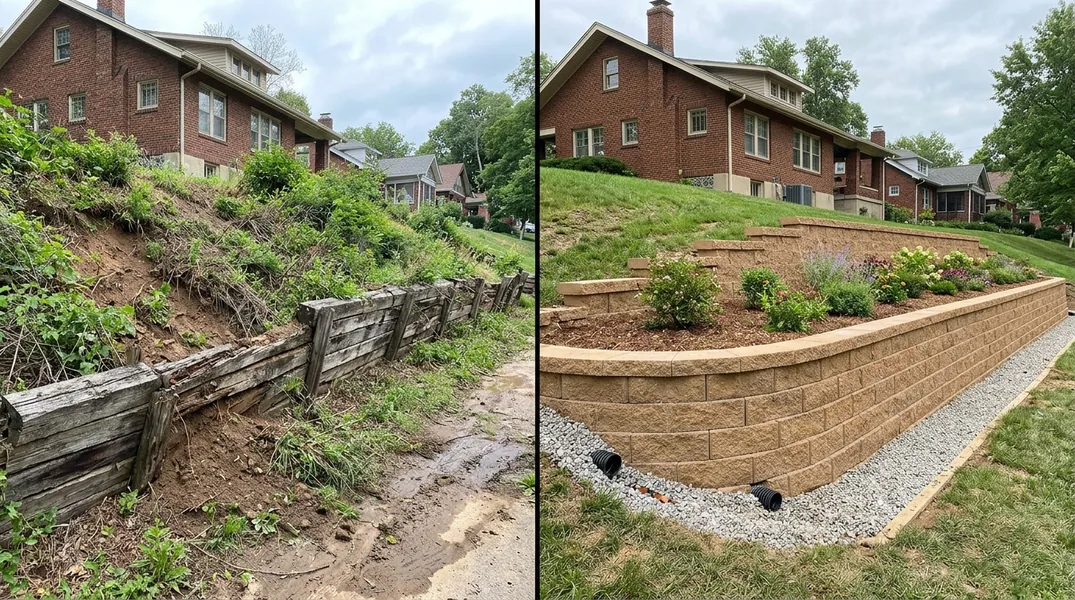
Understanding Indianapolis Clay Soil and Retaining Wall Failure
If you own property in Indianapolis, you've likely noticed the distinctive reddish-brown clay that dominates our region's landscape. While this clay has supported our community for centuries, it presents a unique challenge for retaining wall structures. The problem isn't the clay itself, but rather how it behaves when wet and how it expands and contracts with seasonal moisture changes.
Clay soil in the Indianapolis area has a high plasticity index, meaning it absorbs water readily and swells significantly. When moisture infiltrates behind a retaining wall, the soil pressure increases dramatically. This hydrostatic pressure pushes against the wall with tremendous force, far exceeding what many structures can withstand. Additionally, freeze-thaw cycles during Indiana winters cause the clay to expand further, creating a repeating cycle of stress that gradually weakens even well-built walls. Understanding this geological reality is the first step toward preventing catastrophic failure and knowing when to call for professional Retaining Wall Repair.
Common Warning Signs of a Failing Retaining Wall
A failing retaining wall rarely collapses without warning. Most homeowners simply don't recognize the early signs that their structure is in trouble. The most obvious indicator is a leaning retaining wall, where the structure tilts noticeably away from the soil it's meant to contain. This tilt often starts subtly, just a few degrees, but it accelerates over time as soil pressure increases. If you notice your wall no longer appears perfectly vertical, this is a red flag that internal stress is building.
Another critical warning sign is horizontal cracking or a bowing retaining wall that appears to bulge outward in the middle section. This bow indicates the wall is flexing under pressure and losing its structural integrity. You might also see vertical cracks running up the face of the wall, particularly near the top, or notice that the wall's base is separating from the foundation. Water seeping through the wall face is another telltale sign that hydrostatic pressure is overwhelming the structure's drainage system. If you spot any of these issues, don't delay in contacting a professional. The longer you wait, the more expensive the eventual Retaining Wall Repair will be.
Why Poor Drainage Accelerates Wall Failure in Clay Soil
Drainage is perhaps the single most important factor determining whether a retaining wall survives or fails in clay-rich soil. When a retaining wall is first installed, proper drainage behind the wall is essential. This typically includes a drainage layer of gravel or perforated drain pipe that allows water to flow down and away from the wall face. However, over time, this drainage system can become clogged with fine clay particles, sediment, and organic debris. Once the drainage fails, water has nowhere to go except to accumulate behind the wall.
Accumulated water behind a retaining wall creates tremendous pressure. This hydrostatic pressure acts like an invisible hand pushing the wall outward. In clay soil, the problem is compounded because clay doesn't allow water to permeate easily. The water sits there, pressing harder and harder against the wall with each rainfall and snow melt cycle. This is why retaining walls in Indianapolis often fail during spring months when snowmelt and heavy rains combine. A wall that functions adequately for years can suddenly give way when drainage systems fail. This is why regular inspection and maintenance of drainage systems is crucial for long-term wall integrity.
How Improper Installation Sets Up Future Failure
Not all retaining wall failures stem from soil conditions or maintenance issues. Many failures trace back to improper Retaining Wall Installation from the beginning. Common installation mistakes include insufficient wall height calculations, inadequate foundation depth, improper backfill material, or failure to account for local soil conditions. A wall installed without proper consideration for clay soil's expansion characteristics is essentially a ticking time bomb.
Professional contractors understand that Concrete Retaining Walls and other structures must be engineered specifically for regional conditions. In Indianapolis, this means designing walls with proper setbacks, adequate reinforcement, appropriate foundation depths, and superior drainage systems. It also means using the correct backfill material rather than simply using excavated clay. When walls are installed by inexperienced contractors who don't account for local geology, failure rates increase dramatically. This is why choosing an experienced local contractor familiar with Indianapolis soil conditions is so important for avoiding costly failures down the road.
Retaining Wall Repair Near Me: When Professional Help Is Essential
If you've identified warning signs in your retaining wall, the question becomes whether to attempt repairs yourself or hire a professional. While minor cosmetic issues might be handled by homeowners, structural problems require expertise. A leaning retaining wall or one showing signs of bowing needs immediate professional assessment. Attempting DIY fixes on structural failures can make the problem worse and create safety hazards.
Professional contractors can assess the underlying cause of failure, whether it's drainage problems, soil pressure issues, foundation failure, or installation defects. They can then recommend the most cost-effective solution, whether that's drainage system repair, wall reinforcement, or complete Retaining Wall Replacement. If you're in the Indianapolis area and concerned about your retaining wall, contact Indianapolis Retaining Wall at (463) 217-0386 or request a free estimate to have a professional evaluate your situation.
Retaining Wall Installation Cost in Indianapolis: What to Budget
When facing a failing retaining wall, many homeowners want to understand the financial implications. The cost of addressing a failing wall varies dramatically depending on the severity of the problem and the chosen solution. A simple drainage repair might cost a few hundred dollars, while complete wall replacement could run several thousand. The key factor is how early you catch the problem. Early intervention through drainage improvements or minor reinforcement is significantly cheaper than waiting until the wall fails completely.
When evaluating pricing for repairs or replacement, get multiple quotes from experienced local contractors. Make sure any estimate includes a thorough site assessment and accounts for Indianapolis clay soil conditions. The cheapest option isn't always the best choice, especially when structural integrity is at stake. A well-built replacement wall engineered for local conditions will last decades, while a poorly constructed budget option may fail within years. For a detailed assessment of your specific situation and accurate pricing, contact Indianapolis Retaining Wall today at (463) 217-0386 or request a free estimate online.
Looking for a professional retaining wall contractor in Indianapolis? Indianapolis Retaining Wall responds fast for all your retaining wall needs.
Get a Free QuoteOur services: Retaining Wall Installation · Retaining Wall Repair · Retaining Wall Replacement